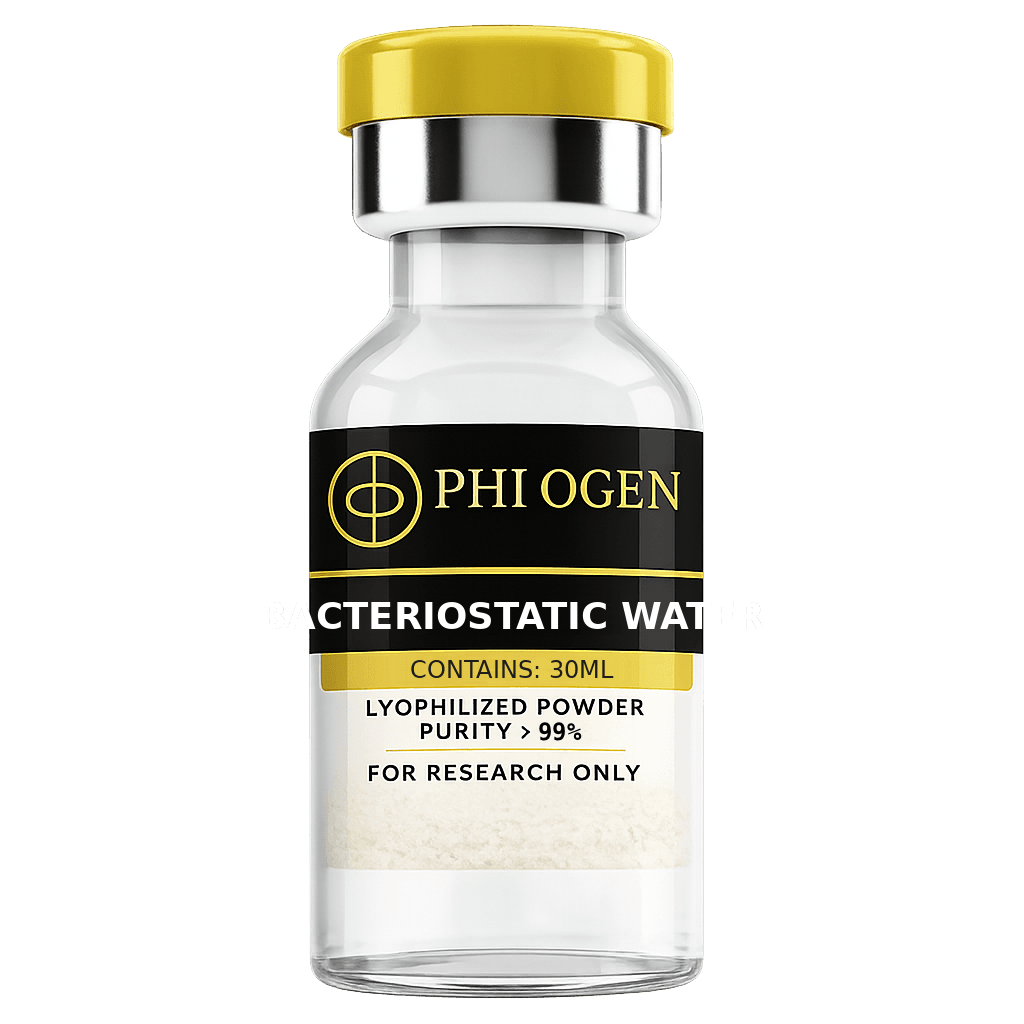
Bacteriostatic Water 30mL
Investigational support for tissue-repair research.
Bacteriostatic water is sterile water containing 0.9% benzyl alcohol as a bacteriostatic preservative. It is the standard reconstitution solvent for lyophilized research peptides — the preservative allows multi-dose use from a single vial over a research window.
Proposed mechanism
Benzyl alcohol at 0.9% inhibits bacterial proliferation in the reconstituted solution, enabling multi-draw protocols without compromising sterility. Without a bacteriostatic agent, reconstituted peptide solutions must be used or discarded immediately.
Research highlights
- Standard reconstitution solvent for lyophilized peptides
- 0.9% benzyl alcohol preservative
- Enables multi-draw research protocols
- Sterile-filtered, USP-grade options available
Research protocol notes
Use sterile technique when drawing from the vial. Most research protocols use 1–3 mL of BAC water per peptide vial to achieve the target working concentration.
Stacking and comparative studies
N/A — this is the reconstitution solvent, not a research compound.
Handling and storage
Store at 20–25 °C. Protect from light. Expires 28 days after first puncture per standard bacteriostatic-water handling.
Frequently asked
What is the difference between BAC water and sterile water?
BAC water contains 0.9% benzyl alcohol as a bacteriostatic agent. Sterile water contains only sterile water — no preservative, meaning reconstituted solutions must be used immediately.
Why 28-day expiry?
The bacteriostatic action of 0.9% benzyl alcohol is reliable for approximately 28 days from first puncture. Beyond that, sterility can no longer be assumed.
What is USP-grade BAC water?
Meeting United States Pharmacopeia standards for purity, sterility, and preservative concentration.
Can I use it for any peptide?
Standard practice in research, with rare exceptions — a small number of peptides interact with benzyl alcohol and require sterile water instead.