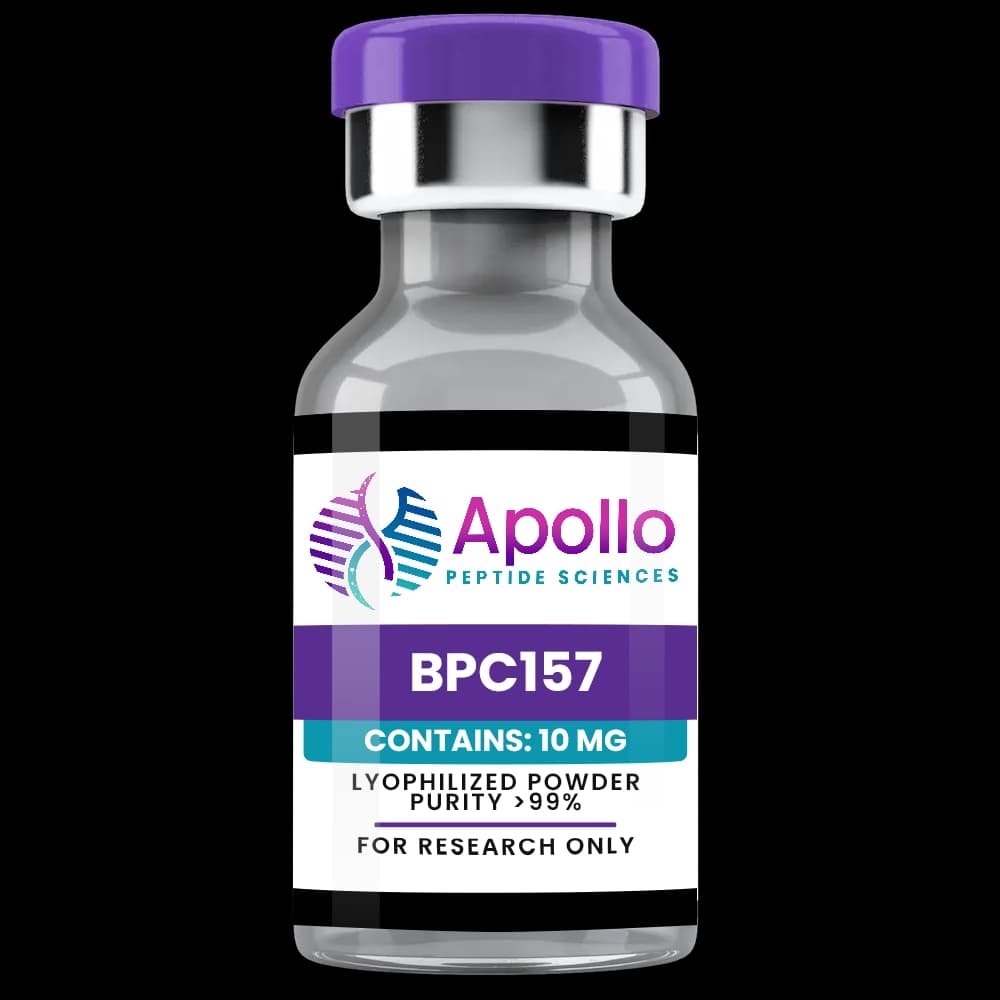
BPC157 10mg
Body Protection Compound 157 — one of the most studied healing peptides for tissue repair and gut health.
How BPC-157 Supports Tissue Repair
In the context of musculoskeletal research, BPC-157 is a synthetic pentadecapeptide composed of 15 amino acids corresponding to a partial sequence of Body Protection Compound (BPC). It accelerates tendon, ligament, and muscle repair through VEGF-driven angiogenesis and growth hormone receptor modulation. Research spans musculoskeletal, gastrointestinal, cardiovascular, and neurological models.
Primary research applications for BPC-157 include accelerated tendon and ligament healing, gut mucosal protection and repair, anti-inflammatory signaling, neuroprotective properties in preclinical models. As a Healing & Recovery compound, it is studied in the context of healing, recovery, gut health — areas where its mechanism of action has the most direct relevance in preclinical models.
In standard research protocols, BPC-157 is administered at 250–500 mcg/day subcutaneous or intramuscular, with a half-life of ~4 hours. This product is supplied by Apollo Peptide Sciences as lyophilized powder with independent third-party Certificate of Analysis (COA) documentation confirming 99%+ purity and correct molecular identity on every batch. BPC157 10mg is sold strictly for laboratory and educational use only — it is not FDA-approved for human therapeutic use and is not intended for human consumption, clinical application, or use in animals.
Dosing Protocol
Dosing information is derived from published animal studies and is provided for educational purposes only.
💎BPC157 10mg for Looksmaxxing
BPC-157 is valued in looksmaxxing protocols primarily for tissue repair, gut health, and vascular support. Its VEGF upregulation drives angiogenesis — new blood vessel formation — which improves nutrient delivery to skin and scalp tissue. In recovery-focused looksmaxxing, it's the go-to compound for healing training injuries without compromising physique progress. It also appears in skin stacks alongside GHK-Cu, where its angiogenic effects complement GHK-Cu's collagen synthesis by improving the vascular environment that supports dermal remodeling.
Applications & Benefits
Frequently Asked Questions
Why do so many researchers gravitate toward BPC-157 specifically?
BPC-157 has built a reputation as a 'does a lot of things well' peptide. In preclinical studies it's been applied to tendon injuries, gut damage, muscle tears, and even neurological models — an unusually broad scope for a single compound. The underlying reason is its multi-pathway mechanism: it doesn't just do one thing, it simultaneously promotes blood vessel growth, activates protective signaling in the gut and cardiovascular system, and interacts with growth hormone receptor pathways. That combination makes it a go-to for researchers studying tissue repair across different biological systems.
How does BPC-157 support gut health alongside musculoskeletal healing?
BPC-157 was originally discovered in gastric juice, which hints at its natural home in the body. It appears to protect and restore the gut's mucosal lining — the barrier between your digestive tract and bloodstream. In animal models, it's been shown to counteract gut damage caused by NSAIDs and other inflammatory insults. The mechanism overlaps with its healing properties elsewhere: angiogenesis and cytoprotective signaling that maintain and restore epithelial barrier integrity. This gut-healing dimension is one of the things that makes BPC-157 uniquely interesting compared to peptides that focus purely on musculoskeletal tissue.
How should reconstituted BPC-157 be stored?
Lyophilized BPC-157 should be stored at -20°C in a dry environment away from light. Once reconstituted with bacteriostatic water, the solution should be refrigerated at 4°C and used within 30 days. Avoid repeated freeze-thaw cycles — each thermal cycle degrades peptide integrity and reduces the active concentration of your solution.
What makes BPC-157 different from other tissue repair peptides like TB-500 or GHK-Cu?
Each of these peptides operates through a different primary mechanism, which is why they're frequently studied together rather than as substitutes. BPC-157 is the most locally angiogenic of the three — it drives blood vessel formation specifically at injury sites, which accelerates the nutrient delivery that healing tissue depends on. TB-500 works more broadly through actin dynamics and cell migration, reaching tissue throughout the whole body. GHK-Cu focuses on collagen synthesis and extracellular matrix gene regulation, making it particularly relevant for skin and connective tissue quality. Used together, these three compounds address different phases and mechanisms of the tissue repair cascade, which is why the BPC-157 + TB-500 combination in particular appears so consistently in recovery-focused research stacks.
Reconstitution Calculator
Calculate exact BAC water volume and dose measurements for BPC157 10mg.
For laboratory use only. This calculator is a reference tool — verify all calculations before use. Always use sterile technique with bacteriostatic water and sterile syringes.
Effectiveness Profile
Relative effectiveness scores derived from published preclinical literature across key endpoints.
Scores are qualitative aggregates from animal and in vitro studies and are not a medical claim. For educational purposes only.
🔬 Mechanism of Action
At the molecular level, BPC-157 works through several converging pathways — which is part of why researchers find it so interesting. Its best-characterized mechanism involves upregulating VEGF (vascular endothelial growth factor), a key signal that triggers the formation of new blood vessels in damaged tissue. More blood flow to an injury means faster nutrient delivery and waste removal, two limiting factors in tissue repair speed. BPC-157 also activates the nitric oxide (NO) pathway, producing vasodilatory and cytoprotective effects across the cardiovascular and gastrointestinal systems — which is why it shows activity in gut health models as well as musculoskeletal ones. On top of that, it appears to interact with growth hormone receptor expression, adding an anabolic signaling layer to its healing profile. The combination of angiogenic, cytoprotective, and GH-related activity across multiple tissue systems is what makes BPC-157 one of the most extensively studied and broadly applicable healing peptides in current preclinical research.
The Three Stages of Tissue Repair
Angiogenesis
New capillary formation at the injury site increases nutrient and oxygen delivery, accelerating the earliest phase of tissue repair.
Recruitment
Fibroblast and stem cell migration to damaged tissue lays the groundwork for structural repair and collagen deposition.
Regeneration
Collagen synthesis, extracellular matrix remodeling, and restoration of mechanical integrity close out the repair cascade.
Effect Timeline
Expected milestones based on published preclinical data.
Growth factor upregulation begins. Anti-inflammatory cytokine modulation and early cellular migration signals activated.
Blood vessel formation accelerates at repair sites. Measurable increase in tissue growth factor expression.
Collagen deposition and matrix remodeling underway. Structural integrity measurably improving in preclinical models.
Healing cycle completes in most preclinical models. Sustained anti-inflammatory state; functional tissue restoration.
Growth factor upregulation begins. Anti-inflammatory cytokine modulation and early cellular migration signals activated.
Blood vessel formation accelerates at repair sites. Measurable increase in tissue growth factor expression.
Collagen deposition and matrix remodeling underway. Structural integrity measurably improving in preclinical models.
Healing cycle completes in most preclinical models. Sustained anti-inflammatory state; functional tissue restoration.
Timelines are derived from preclinical animal studies. Individual results in laboratory settings may vary. For educational purposes only.
Synergistic Stack Combinations
BPC-157 at a Glance
Key Study Findings
Tendon-to-bone healing accelerated in rodent models through VEGF-driven angiogenesis — new vessel formation documented directly at injury sites within days of administration
Gastroprotective effects demonstrated against NSAID-induced gut lesions, restoring mucosal integrity and preventing ulcer progression in multiple animal study models
Bidirectional modulation of dopaminergic and serotonergic systems observed — suggesting neurochemical activity that extends well beyond musculoskeletal and gut tissue repair
Systemically active whether delivered locally or systemically, giving BPC-157 unusual design versatility across different preclinical study protocols
Nitric oxide pathway activation linked to cytoprotective effects in cardiac and vascular tissue models — expanding its potential research scope into cardiovascular biology
Shown to counteract the toxicity of certain substances in animal models, pointing to a broader cytoprotective role in systemic organ protection research
Related Topics
BPC-157
For educational use only · Verified vendor