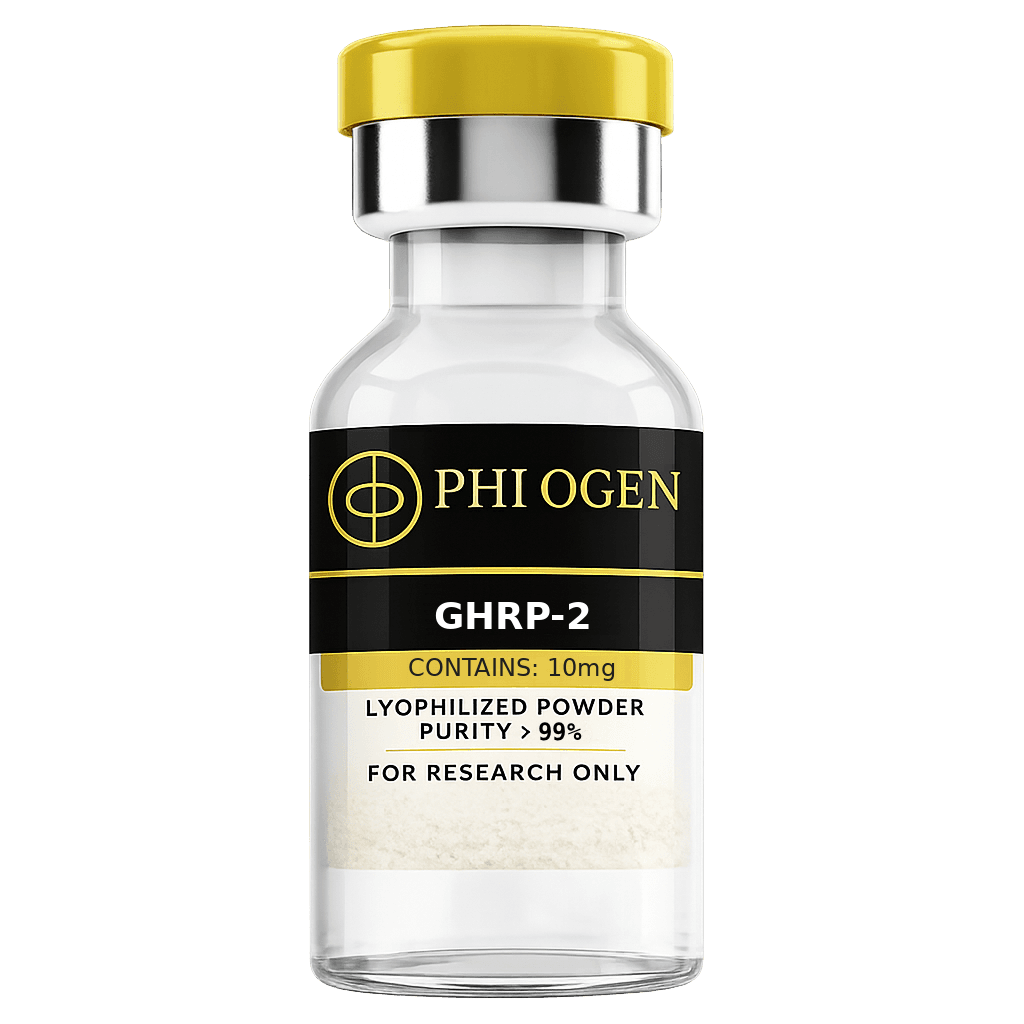
GHRP-2 10mg
Studied for growth-axis and performance research.
GHRP-2 is a hexapeptide ghrelin-receptor agonist, one of the earliest GHRPs developed. It is a benchmark compound in growth-hormone-secretagogue research — studied alongside newer analogs like ipamorelin and hexarelin.
Proposed mechanism
GHRP-2 binds the GHS-R1a (ghrelin) receptor in the anterior pituitary and hypothalamus, driving GH release and appetite signaling. Its HPA-axis engagement (cortisol/prolactin) is greater than newer selective analogs.
Research highlights
- Early-generation hexapeptide GHRP
- Strong GH-release profile in research
- Appetite-stimulating effects via ghrelin receptor
- Benchmark comparison compound for newer secretagogues
Research protocol notes
Reconstitute under sterile technique with bacteriostatic water. Typical volumes range from 1–3 mL depending on the target working concentration. Swirl gently — do not shake — to avoid peptide shearing.
Stacking and comparative studies
Often combined with GHRH analogs (CJC-1295, Tesamorelin) in dual-pathway GH research.
Handling and storage
Lyophilized powder is stable at ambient shipping temperatures. Once reconstituted with bacteriostatic water, store at 2–8 °C and use within 28 days. For long-term storage of unreconstituted vials, freeze at −20 °C and protect from light.
Frequently asked
How does GHRP-2 differ from ipamorelin?
GHRP-2 has stronger HPA-axis effects (cortisol, prolactin). Ipamorelin is more selective for GH release. Both act on the same ghrelin receptor.
How does it differ from GHRP-6?
GHRP-6 produces substantially more appetite stimulation and prolactin elevation. GHRP-2 is "cleaner" but less selective than ipamorelin.
What is its half-life?
Short — under 30 minutes in research models.
Is it combined with GHRH analogs?
Yes — dual-pathway GH research stacks GHRH + GHRP for amplified release.