
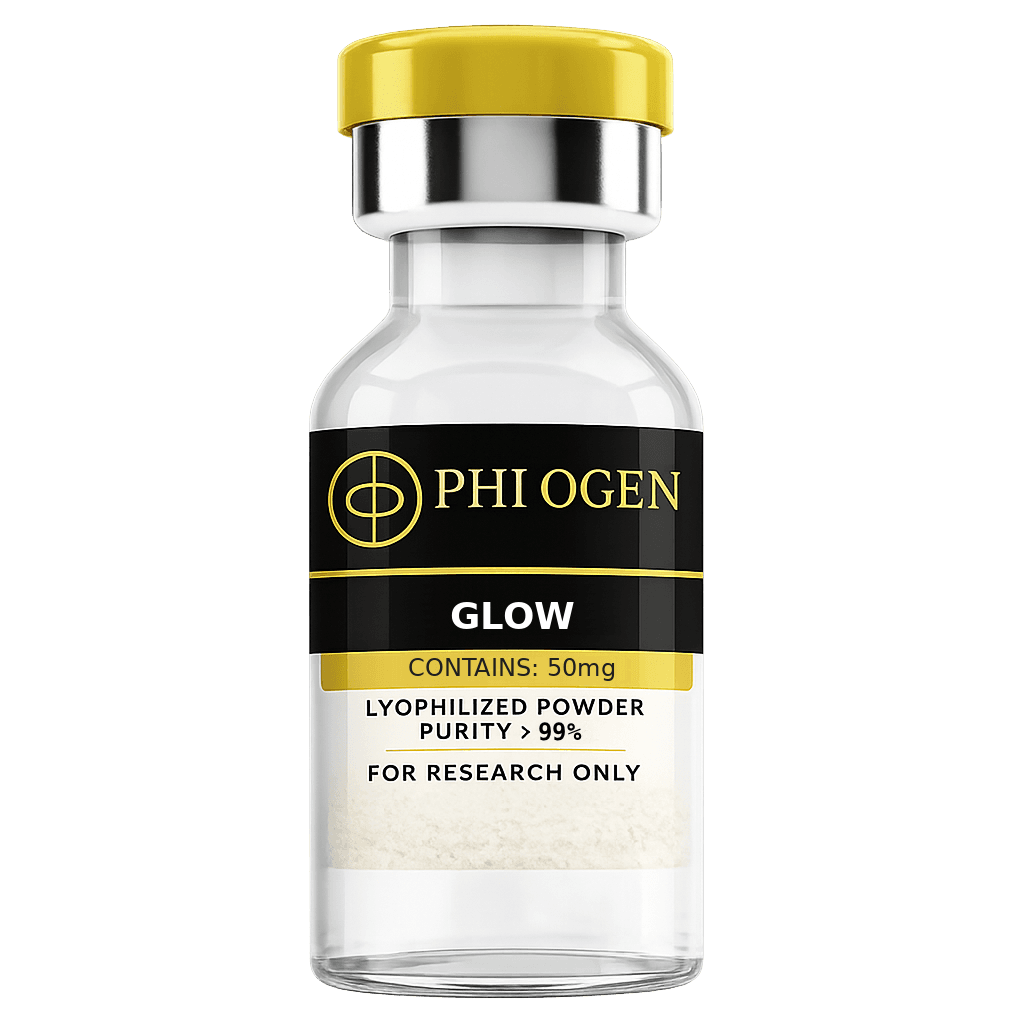
Order GLOW Blend — Pre-Mixed Pathway Vial
Bundling additive-outcome endpoints — combination-repair research.
GLOW is a pre-blended multi-peptide research combination built around GHK-Cu and repair peptides, intended for cosmetic-research and tissue-study designs. The exact formulation varies by concentration format (50 mg vs 70 mg).
Blend composition
Each vial ships as a single lyophilized cake. The supplier measures each constituent before co-mixing so reconstitution yields the stated mg of each peptide per mL.
Blend ratio is lot-verified via HPLC and documented on the per-lot certificate of analysis.
Available sizes
Mechanism in the literature
Combines GHK-Cu (copper-peptide collagen/ECM modulator) with supporting repair peptides. Designed as a single-reconstitution research tool for combined cosmetic and tissue-research endpoints.
Research use-cases
- Multi-peptide research blend
- Built around GHK-Cu
- Single-vial reconstitution
- Available in 50 mg and 70 mg total-mass formats
Often paired with
Buyers viewing GLOW Blend typically also consider Cagri-Reta, BPC-157 + TB-500 Blend and IPA/TESA Blend (15 mg Total). Each is in stock, sealed under nitrogen with a lot-matched CoA.
Handling in the lab
Reconstitute under sterile technique with bacteriostatic water. Typical volumes range from 1–3 mL depending on the target working concentration. Swirl gently — do not shake — to avoid peptide shearing.
Stacking and paired-compound work
This is the stack.
Key facts
- Multi-peptide research blend
- Built around GHK-Cu
- Single-vial reconstitution
- Available in 50 mg and 70 mg total-mass formats
Frequently asked
What is in the GLOW blend?
GHK-Cu plus complementary research peptides (typically BPC-157 and TB-500 variants). See the supplier product page for exact per-component specs.
What is the difference between 50 mg and 70 mg?
Total peptide mass per vial. The 70 mg format typically uses larger per-component masses rather than adding new components.
What is it used for in research?
Combined cosmetic/repair research — skin models, wound-healing studies, ECM-remodeling protocols.
Is each component COA-verified?
Yes — per-lot testing covers each component.
More Blends compounds
 2 sizes-10%
 -10%
-10% 2 sizes-10%
 -10%
-10%