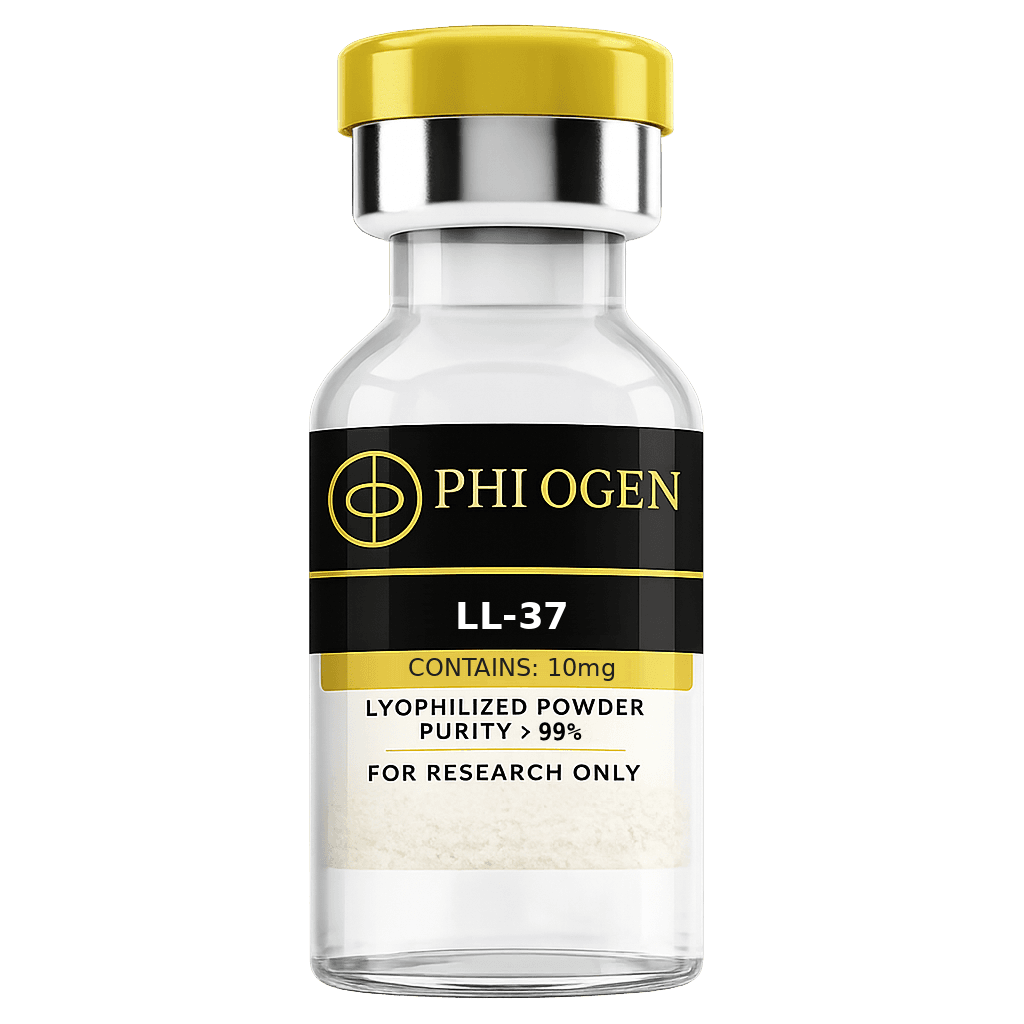
LL-37 10mg
Investigational support for tissue-repair research.
LL-37 (cathelicidin-derived) is a 37-amino-acid human antimicrobial peptide and a central member of the innate-immunity peptide family. It is studied across antimicrobial, immunomodulatory, and wound-repair research contexts.
Proposed mechanism
LL-37 has direct antimicrobial activity against a broad spectrum of bacteria, fungi, and viruses. It also modulates host immune signaling — chemotaxis, cytokine release, and epithelial repair are all within its documented activity profile.
Research highlights
- Only human cathelicidin-derived antimicrobial peptide
- Broad-spectrum antimicrobial activity in vitro
- Simultaneously immunomodulatory
- Central entry in innate-immunity peptide research
Research protocol notes
Reconstitute under sterile technique with bacteriostatic water. Typical volumes range from 1–3 mL depending on the target working concentration. Swirl gently — do not shake — to avoid peptide shearing.
Stacking and comparative studies
Typically studied alone in antimicrobial research.
Handling and storage
Lyophilized powder is stable at ambient shipping temperatures. Once reconstituted with bacteriostatic water, store at 2–8 °C and use within 28 days. For long-term storage of unreconstituted vials, freeze at −20 °C and protect from light.
Frequently asked
What is cathelicidin?
A family of antimicrobial peptide precursors. LL-37 is the only mature peptide derived from the human cathelicidin gene (CAMP).
What organisms has it been studied against?
Gram-positive and Gram-negative bacteria, mycobacteria, fungi, and some viruses. It is one of the most broadly active human AMPs.
Is LL-37 studied beyond antimicrobial research?
Yes — wound repair, inflammation modulation, and cancer-adjacent research all appear in the literature.
Why is it called LL-37?
The peptide starts with two leucines (LL) and is 37 residues long.