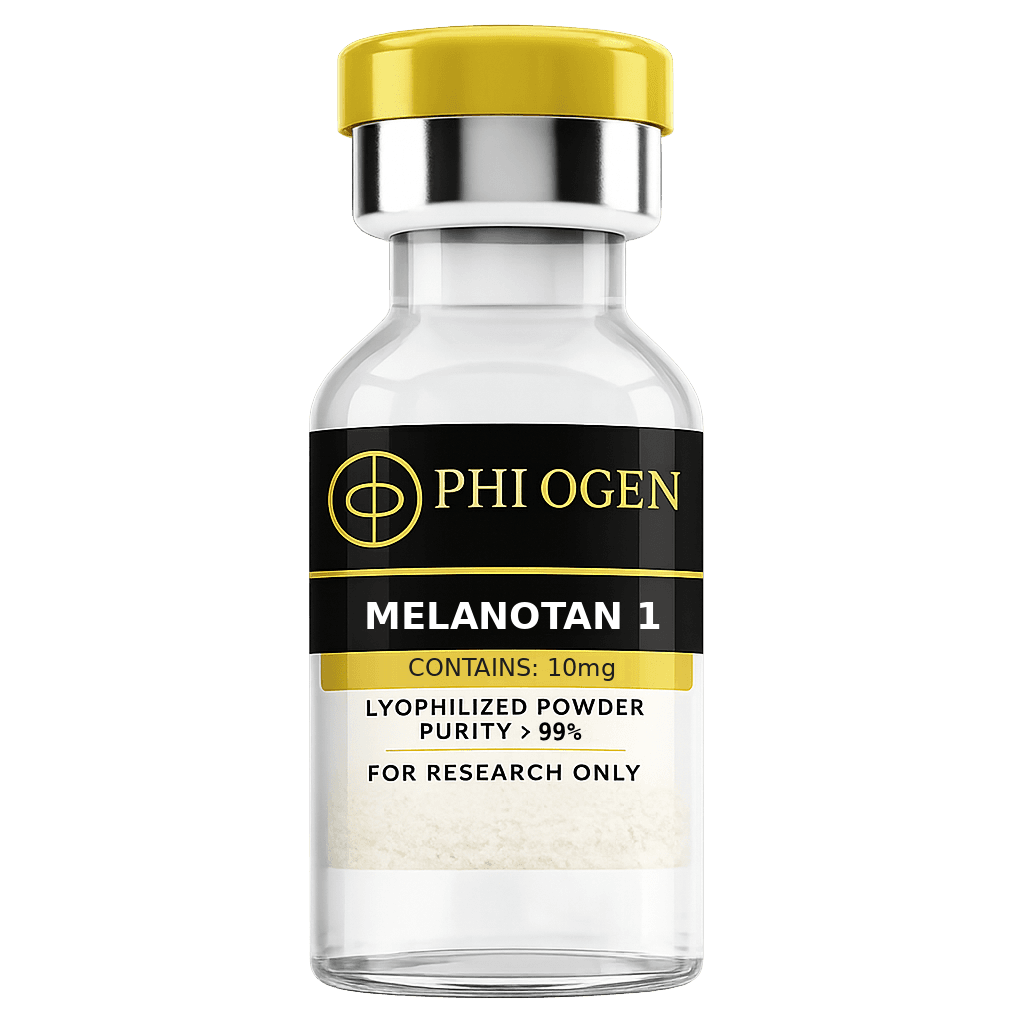
Melanotan I 10mg
Compounds used in longevity and anti-senescence research.
Melanotan I (afamelanotide) is a synthetic α-MSH analog engineered for stability, studied primarily in pigmentation and photoprotection research. It is more selective for MC1R than Melanotan II.
Proposed mechanism
Melanotan I is a potent MC1R agonist. MC1R activation on melanocytes drives eumelanin synthesis — the basis for its use in research on erythropoietic protoporphyria and other photosensitivity models.
Research highlights
- MC1R-selective α-MSH analog
- Also known as afamelanotide
- Studied in photoprotection and pigmentation research
- More selective profile than Melanotan II
Research protocol notes
Research protocols use subcutaneous administration with gradual titration schedules. Reconstitute in BAC water and aliquot.
Stacking and comparative studies
Typically studied alone.
Handling and storage
Lyophilized powder is stable at ambient shipping temperatures. Once reconstituted with bacteriostatic water, store at 2–8 °C and use within 28 days. For long-term storage of unreconstituted vials, freeze at −20 °C and protect from light.
Frequently asked
What is the difference between MT1 and MT2?
Melanotan I is more MC1R-selective. Melanotan II activates multiple melanocortin receptors, which is why it has broader research applications but also broader endpoint profiles.
What is afamelanotide?
The pharmaceutical name for Melanotan I — marketed as Scenesse for erythropoietic protoporphyria.
How is pigmentation studied?
Through melanocyte-activity assays and in-vivo models of UV-response and photoprotection.
Is a COA included?
Yes — each lot ships with independent testing.