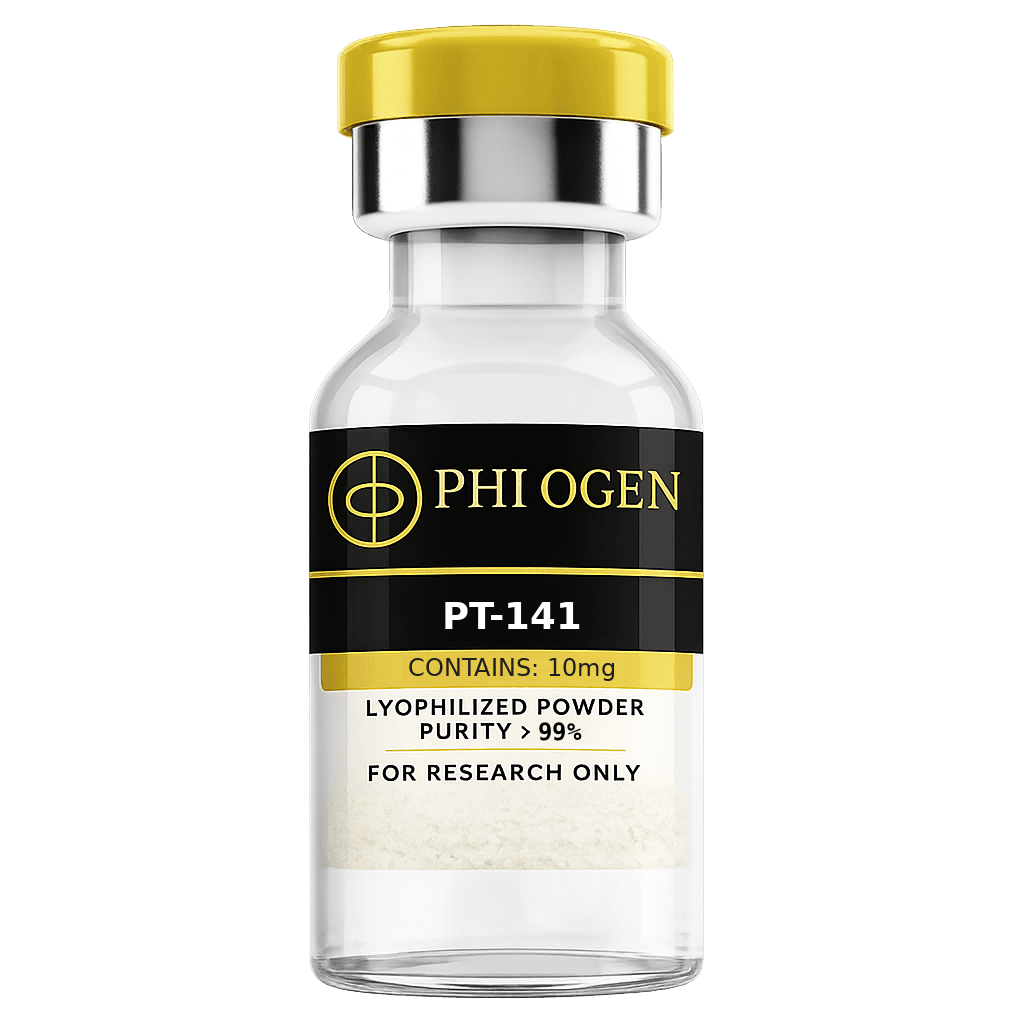
PT-141 10mg
Compounds used in longevity and anti-senescence research.
PT-141 (bremelanotide) is a synthetic melanocortin-receptor agonist developed from the α-MSH peptide lineage. It is one of the best-known entries in the melanocortin-pathway research literature, with a focus on central-nervous-system activation.
Proposed mechanism
PT-141 acts primarily on MC4R (melanocortin-4 receptor) in the central nervous system. MC4R is a key node in both energy-balance and central-sexual-response circuits — the basis for the two main lines of PT-141 research.
Research highlights
- MC4R-selective melanocortin agonist
- CNS-active — crosses the blood-brain barrier
- Studied in both sexual-response and appetite-regulation research
- Shorter half-life than melanotan analogs
Research protocol notes
Research protocols commonly reconstitute in BAC water and use subcutaneous administration. Pulsed protocols dominate over continuous dosing.
Stacking and comparative studies
PT-141 is typically studied alone rather than in stacks. Melanotan I/II are related compounds but have different receptor selectivity profiles.
Handling and storage
Lyophilized powder is stable at ambient shipping temperatures. Once reconstituted with bacteriostatic water, store at 2–8 °C and use within 28 days. For long-term storage of unreconstituted vials, freeze at −20 °C and protect from light.
Frequently asked
Is PT-141 the same as Vyleesi?
Vyleesi is a pharmaceutical formulation of bremelanotide (PT-141). Research-grade material sold here is for laboratory use only.
How does it differ from Melanotan II?
Melanotan II is a broader-spectrum melanocortin agonist that also activates MC1R (pigmentation). PT-141 is more MC4R-selective and does not drive pigmentation to the same degree.
What is MC4R?
Melanocortin-4 receptor — a central-nervous-system target involved in appetite regulation and sexual-response circuits.
What is its half-life?
Short — hours rather than days. Research protocols reflect this with pulsed dosing.