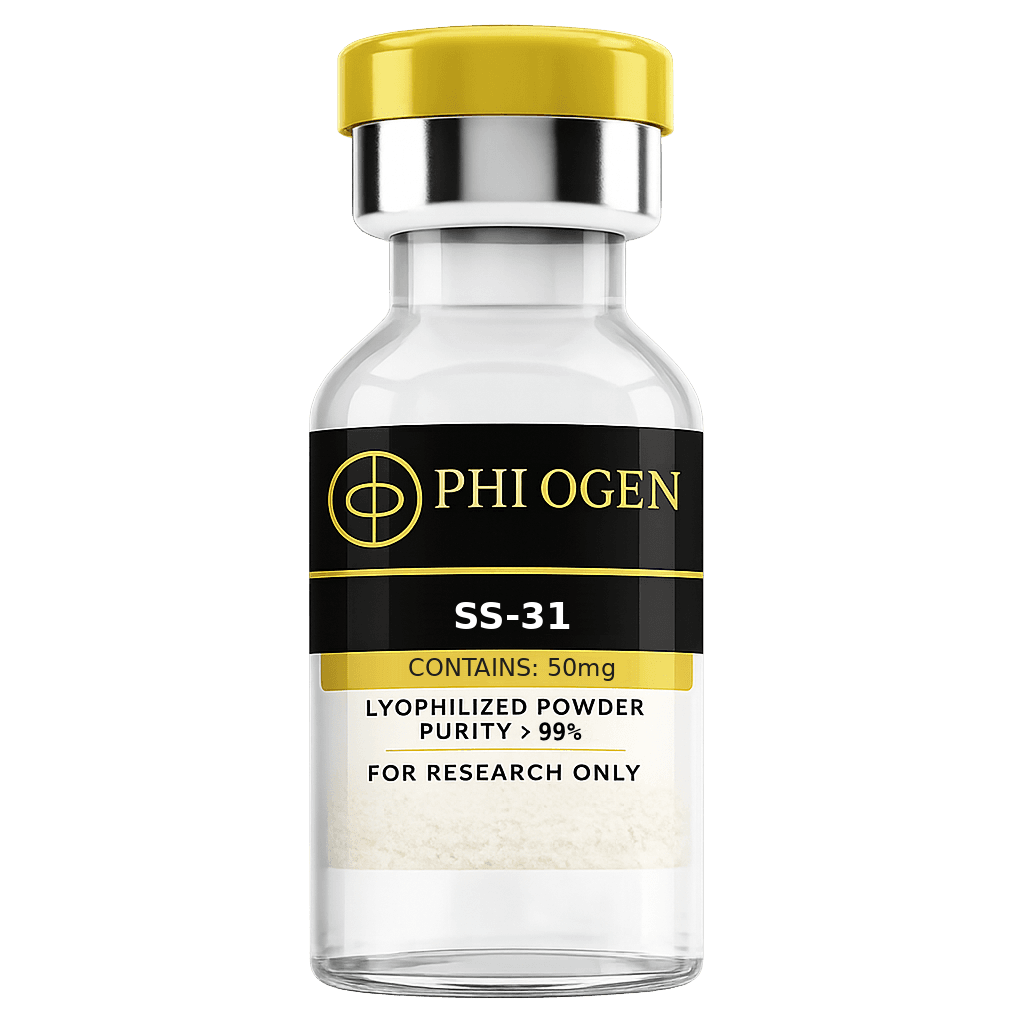
SS-31 50mg
Investigational support for tissue-repair research.
SS-31 (elamipretide) is a mitochondria-targeting tetrapeptide that concentrates in the inner mitochondrial membrane by binding cardiolipin. It is one of the most actively studied compounds in mitochondrial-medicine research.
Proposed mechanism
SS-31 binds cardiolipin — a phospholipid exclusive to the inner mitochondrial membrane — stabilizing cristae architecture and protecting electron-transport-chain function under oxidative stress. Research spans cardiac, neurological, and renal ischemia-reperfusion models.
Research highlights
- Cardiolipin-binding mitochondrial peptide
- Also known as elamipretide (Bendavia, MTP-131)
- Studied in cardiac, renal, and neurodegeneration models
- Available in 10, 25, and 50 mg research vials
Research protocol notes
Injectable research protocols dominate. Daily or alternate-day administration is typical in mitochondrial-dysfunction models.
Stacking and comparative studies
Mitochondrial research stacks frequently combine SS-31 with MOTS-c and NAD+ for orthogonal mitochondrial-support coverage.
Handling and storage
Lyophilized powder is stable at ambient shipping temperatures. Once reconstituted with bacteriostatic water, store at 2–8 °C and use within 28 days. For long-term storage of unreconstituted vials, freeze at −20 °C and protect from light.
Frequently asked
What is the difference between SS-31 and elamipretide?
Same compound, different names — SS-31 is the research designation, elamipretide is the pharmaceutical name.
What is cardiolipin?
A phospholipid unique to the inner mitochondrial membrane. SS-31 binds it selectively, which is why the peptide accumulates in mitochondria.
Which tissues have been studied most?
Cardiac ischemia-reperfusion models dominate the literature, followed by renal and neurological research.
Can SS-31 be stacked with other mitochondrial peptides?
Research designs commonly combine SS-31 with MOTS-c and NAD+ to cover distinct mitochondrial-support pathways.