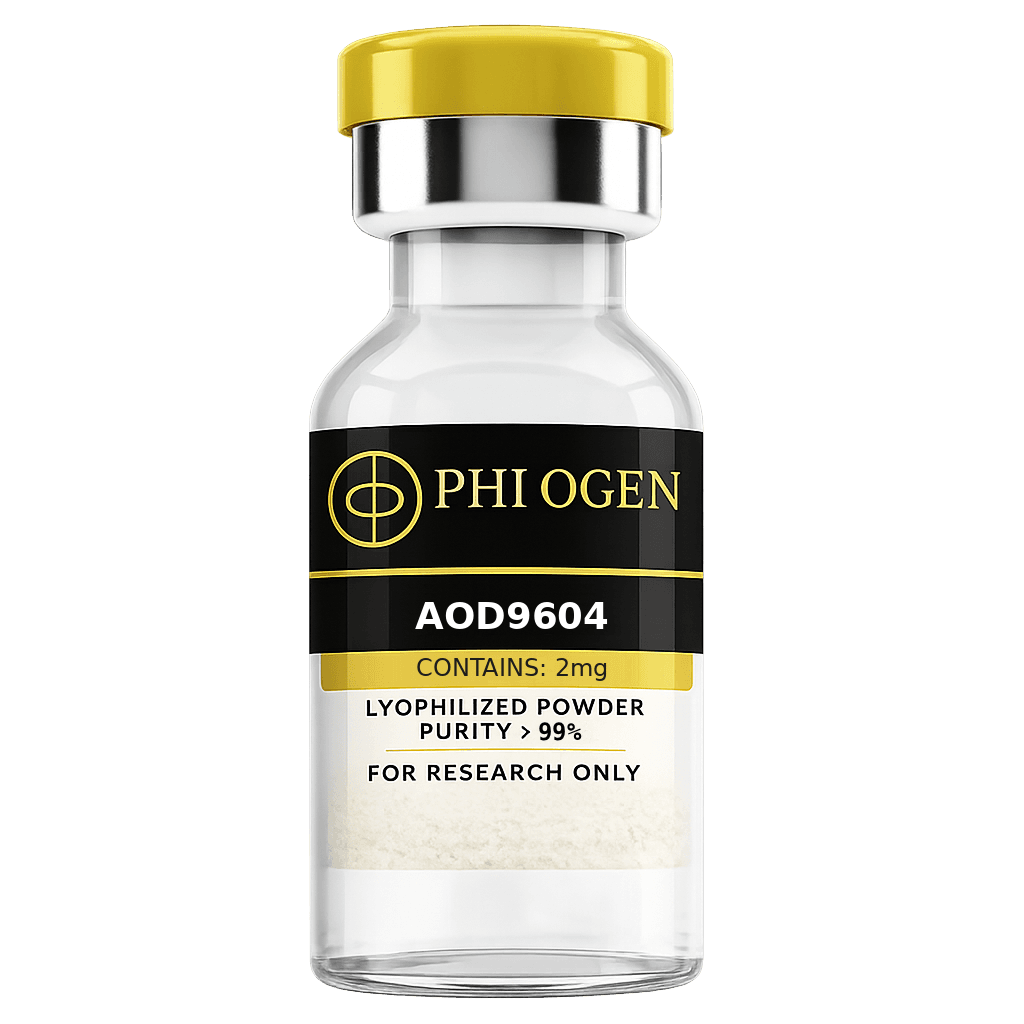
AOD9604 2mg
Metabolic support for body recomposition research.
AOD9604 is a synthetic fragment of the human growth hormone (residues 176–191), engineered to retain the lipolytic activity of GH without its growth-promoting effects. It is studied primarily in fat-metabolism research.
Proposed mechanism
AOD9604 is proposed to mimic the lipolytic tail region of GH, stimulating lipolysis and inhibiting lipogenesis in adipocytes without activating the full GH-receptor signaling cascade. This separation of effects is the engineering rationale.
Research highlights
- Modified fragment of hGH 176–191
- Engineered to isolate lipolytic from growth-promoting effects
- Studied in adipocyte and body-composition research
- Multiple research vial sizes (2, 5, 10 mg)
Research protocol notes
Reconstitute under sterile technique with bacteriostatic water. Typical volumes range from 1–3 mL depending on the target working concentration. Swirl gently — do not shake — to avoid peptide shearing.
Stacking and comparative studies
Sometimes studied alongside other metabolic-research compounds.
Handling and storage
Lyophilized powder is stable at ambient shipping temperatures. Once reconstituted with bacteriostatic water, store at 2–8 °C and use within 28 days. For long-term storage of unreconstituted vials, freeze at −20 °C and protect from light.
Frequently asked
Is AOD9604 the same as growth hormone?
No — it is a small modified fragment corresponding to residues 176–191 of hGH. The fragment isolates lipolytic activity from the full GH signaling profile.
What does "AOD" stand for?
Anti-Obesity Drug — the original research designation when the compound was developed by Metabolic Pharmaceuticals.
Why multiple vial sizes?
Research concentration and duration vary. 2 mg for short pilots, 10 mg for longer protocols.
How does it compare to tirzepatide/semaglutide?
Different mechanism entirely — AOD9604 acts on adipocyte lipolysis; GLP-1-class compounds act on appetite and insulin signaling.